Lindsey in the News (Winnipeg Free Press December 14, 2023)
By Joyanne Pursaga
AFTER a fresh coat of snow fell on already icy residential roads and collector streets, leading some to resemble skating rinks, some Winnipeggers are urging the city to ramp up efforts to improve traction.
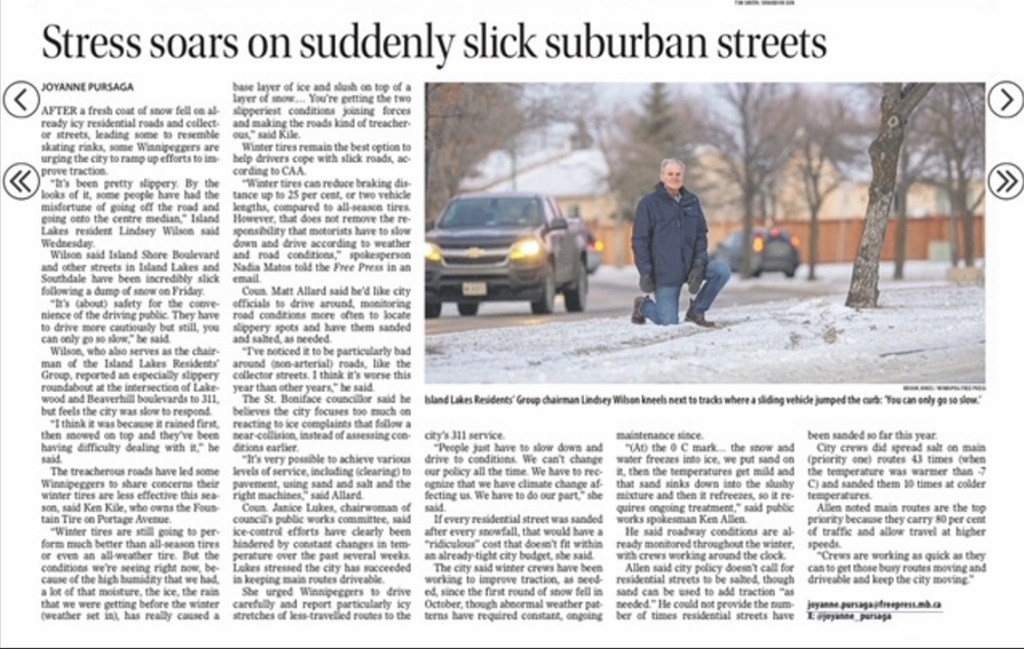
“It’s been pretty slippery. By the looks of it, some people have had the misfortune of going off the road and going onto the centre median.” Island Lakes resident Lindsey Wilson said Wednesday.
Wilson said Island Shore Boulevard and other streets in Island Lakes and Southdale have been incredibly slick following a dump of snow on Friday.
“It’s (about) safety for the convenience of the driving public. They have to drive more cautiously but still, you can only go so slow,” he said.
Wilson, who also serves as the chairman of the Island Lakes Residents’ Group, reported an especially slippery roundabout at the intersection of Lakewood and Beaverhill boulevards to 311, but feels the city was slow to respond.
“I think it was because it rained first, then snowed on top and they’ve been having difficulty dealing with it,” he said.
The treacherous roads have led some Winnipeggers to share concerns their winter tires are less effective this season, said Ken Kile, who owns the Fountain Tire on Portage Avenue.
“Winter tires are still going to perform much better than all-season tires or even an all weather tire. But the conditions we’re seeing right now, because of the high humidity that we had, a lot of that moisture, the ice, the rain that we were getting before the winter (weather set in), has really caused a base layer of ice and slush on top of a layer of snow…. You’re getting the two slipperiest conditions joining forces and making the roads kind of treacherous,” said Kile.
Winter tires remain the best option to help drivers cope with slick roads, according to CAA.
“Winter tires can reduce braking distance up to 25 per cent, or two vehicle lengths, compared to all-season tires. However, that does not remove the responsibility that motorists have to slow down and drive according to weather and road conditions,” spokesperson Nadia Matos told the Free Press in an email.
Coun. Matt Allard said he’d like city officials to drive around, monitoring road conditions more often to locate slippery spots and have them sanded and salted, as needed.
“I’ve noticed it to be particularly bad around (non-arterial) roads, like the collector streets. I think it’s worse this year than other years,” he said.
The St. Boniface councillor said he believes the city focuses too much on reacting to ice complaints that follow a near-collision instead of assessing conditions earlier.
“It’s very possible to achieve various levels of service, including (clearing) to pavement, using sand and salt and the right machines,” said Allard.
Coun. Janice Lukes, chairwoman of council’s public works committee, said ice-control efforts have clearly been hindered by constant changes in temperature over the past several weeks. Lukes stressed the city has succeeded in keeping main routes driveable.
She urged Winnipeggers to drive carefully and report particularly icy stretches of less-travelled routes to the city’s 311 service.
“People just have to slow down and drive to conditions. We can’t change our policy all the time. We have to recognize that we have climate change affecting us. We have to do our part,” she said.
If every residential street was sanded after every snowfall, that would have a “ridiculous” cost that doesn’t fit within an already-tight city budget, she said.
The city said winter crews have been working to improve traction, as needed, since the first round of snow fell in October, though abnormal weather patterns have required constant, ongoing maintenance since.
“(At) the 0 C mark….the snow and water freezes into ice, we put sand on it, then the temperatures get mild and that sand sinks down into the slushy mixture and then it refreezes, so it requires ongoing treatment,” said public works spokesman Ken Allen.
He said roadway conditions are already monitored throughout the winter, with crews working around the clock.
Allen said city policy doesn’t call for residential streets to be salted, though sand can be used to add traction “as needed”. He could not provide the number of times residential streets have been sanded so far this year.
City crews did spread salt on main (priority one) routes 43 times (when the temperature was warmer than .7 C) and sanded them 10 times at colder temperatures.
Allen noted main routes are the top priority because they carry 80 per cent of traffic and allow travel at higher speeds.
“Crews are working as quick as they can to get those busy routes moving and driveable and keep the city moving.”
joyanne.pursaga@freepress.mb.ca
 ISLAND LAKES RESIDENTS' GROUP